

Qns 11.
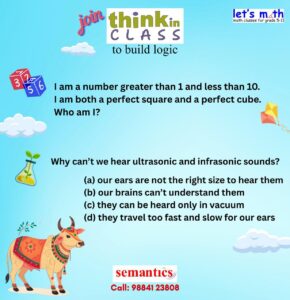
I am a number greater than 1 and less than 10. I am both a perfect square and a perfect cube. Who am I?
Ans: 64
64 = 82 → It is a perfect square of 8
64 = 43 → It is a perfect cube of 4
Qns 12.
Why can’t we hear ultrasonic and infrasonic sounds?
1. our ears are not the right size to hear them
2. our brains can’t understand them
3. they can be heard only in vacuum
4. they travel too fast and slow for our ears
Ans: (4) they travel too fast and slow for our ears
Humans cannot hear ultrasonic or infrasonic sound waves because of the limitations of the human ear.
Infrasonic sounds have frequencies below 20 Hz. These vibrations are too slow to stimulate the eardrum and the tiny hair cells in the inner ear effectively, so the brain does not register them as sound.
Ultrasonic sounds have frequencies above 20,000 Hz. These vibrations are too fast for the eardrum and cochlear hair cells to respond to, so they cannot be converted into nerve signals.
The human ear is designed to detect sounds only in the Audible frequency range of 20 Hz to 20,000 Hz. Sounds outside this range may still exist and even affect us physically, but we cannot hear them.
Qns 9
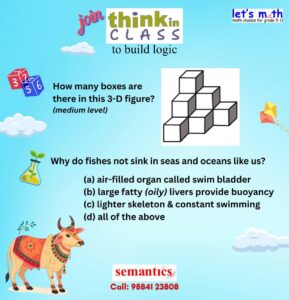
How many boxes are there in this 3-D figure? (medium level)
Ans:
The ground level(level 1) – has 3 cubes visible and 3 hidden = 6 cubes
Level 2 has 2 cubes visible and one hidden = 3 cubes
Level 3 has 1 cube.
Total = 6+3+1 =10
Qns 10
Why do fishes not sink in seas and oceans like us?
1. air-filled organ called swim bladder
2. large fatty (oily) livers provide buoyancy
3. lighter skeleton & constant swimming
4. all of the above
Ans: (4) all of the above
Fish don’t sink because bony fishes have a gas-filled organ called swim bladder. It acts like an internal balloon that lets them adjust their buoyancy to stay at certain depths without sinking deeper or floating up. Cartilaginous fishes like sharks have fatty or oily liver. Oil being less denser than water creates buoyancy. This combined with cartilage for a skeleton which is very light weight and continuous swimming generates lift preventing them from sinking. Other fishes like eels have lighter bones to prevent them from sinking. Fishes inhabit the depths of seas and oceans that are safe for them in terms of water pressure.
Qns 7
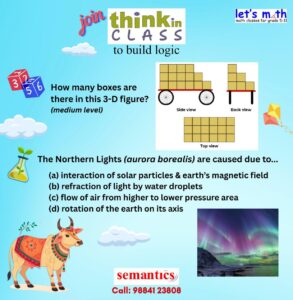
How many boxes are there in the 3-D figure? (medium level)
Ans: 36 boxes
Consider the figure from the Back view, the first column on the left has 3 rows of boxes and from the Side view we can see that there are 6 columns. So, the number of boxes in the first column are = 3 × 6 = 18 boxes.
Again from the Back view, we can see that the middle column has 2 rows of boxes and from the Side view there are 6 such columns. So, the number of boxes in the middle column are = 2 × 6 = 12 boxes.
Lastly, the third column has a height of only 1 box as seen from the Back view and 6 such columns as shown in the Side view. So, the number of boxes in the third (last) column are = 1 × 6 = 6 boxes. The Top view shows that no columns are empty.
Therefore, the total number of boxes are = 18 + 12 + 6 = 36 boxes.
Qns 8
The Northern Lights (aurora borealis) are caused due to…
1. interaction of solar particles & earth’s magnetic field
2. refraction of light by water droplets
3. flow of air from higher to lower pressure area
4. rotation of the earth on its axis
Ans: (1) interaction of particles & earth’s magnetic field
The Sun emits a continuous stream of charged particles (electrons, protons and alpha particles) called the Solar Wind. Some of these particles get trapped in the Earth’s magnetic field. The Earth’s magnetic pull makes these particles spiral towards the North and South poles. While spiralling these particles collide with the nitrogen and oxygen atoms and molecules and transfer their energy to these atmospheric gases making them excited. In order to return to their normal energy state, these excited atoms and molecules release the excess energy in the form of photons (waves of light) which can be seen as auroras or the curtains of green, blue, purple and red lights. These are called Northern Lights (Aurora Borealis) near the Arctic, in countries such as Alaska, Canada, Greenland, Iceland, Norway, Sweden and Finland and are called Southern Lights (Auroras Australis) near the Antarctic and can be viewed from Tasmania, New Zealand and southern tips of South America.
Qns 5
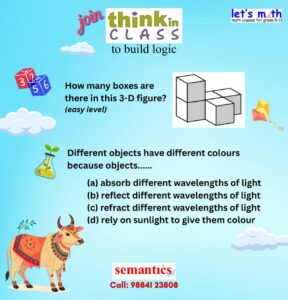
How many boxes are there in this 3-D figure?
Ans: 5 boxes
Count each layer. Base layer has 4 boxes visible. No boxes hidden. The layer above has 1 visible box. Hence 4+1 = 5.
Qns 6
Different objects have different colours because objects……
1. absorb different wavelengths of light
2. reflect different wavelengths of light
3. refract different wavelengths of light
4. rely on sunlight to give them colour
Ans: (2) reflect different wavelengths of light
Sunlight or white light consists of different wavelengths of light. The surface of an object absorbs different wavelengths of light and the unabsorbed wavelengths of light are reflected back. The reflected wavelengths of light are absorbed by the retina in our eye and so the colour of the object is detected. An apple appears red because it reflects red, leaves appear green due to reflection of green. Objects that appear white reflect all the colours equally and objects that appear black do not reflect any wavelength, and instead absorb all the light. The structure of molecules of an object determines the wavelengths of light that are absorbed and reflected.
Qns 3.
A restaurant buys 7 sacks of potatoes with 30 potatoes in each sack. If the total weight of potatoes bought is 31.5 kgs. How much does one potato weigh in grams?
Ans: 150 g
Weight of 7 sacks of potatoes = 31.5 kg
Weight of 1 sack = 31.5/7 = 4.5 kg
One sack has 30 potatoes
Now, Weight of 1 potato = Weight of sack/No. of potatoes = 4.5/30 = 0.15 kg
Converting into grams = 0.15 × 1000 = 150 g
Qns 4.
Why does ice float on water?
1. Water is warmer than ice 2. Water is denser than ice
3. Ice is colder than water 4. Ice is denser than water
Ans: (4) Ice is denser than water
When water freezes, hydrogen bonds lock the molecules into an open, hexagonal structure. This structure spaces the molecules farther apart than in liquid water. With the same mass but more volume, ice has lower density than liquid water and so it floats on the surface.
This phenomenon is observed when lakes freeze on the surface and aquatic life can survive in the unfrozen water below. It is also why icebergs and glaciers float in oceans and rivers.
Qns 1
If 450g of rice is enough for 5 people, how many kilograms of rice would you buy for 12 relatives visiting your family of 4 members for Pongal?
Ans: 1.44 kg
Amount of rice needed for one person = 450g/5 = 90g
Total number of people = 12 relatives + 4 family members = 16 people
Rice needed = No. of people × Rice for one person
= 16 × 90 g = 1440g = 1.44 kg
Qns 2:
Why does sweat not evaporate easily in places like Chennai, Goa or Kanyakumari, in summer?
1.High temperatures
2. Low wind speed
3. High relative humidity/ water vapour in the air
4. High atmospheric pressure
Ans: (c) High relative humidity.
Relative humidity is the measure of water vapour or moisture content in the air. Coastal cities like Chennai, Goa or Kanyakumari are near the Arabian sea, Pacific Ocean and the Indian Ocean respectively and so have a higher moisture content in the air, so when we sweat it does not dry up easily. This can be experienced in other places such as in areas around large water bodies and in rainforests.